
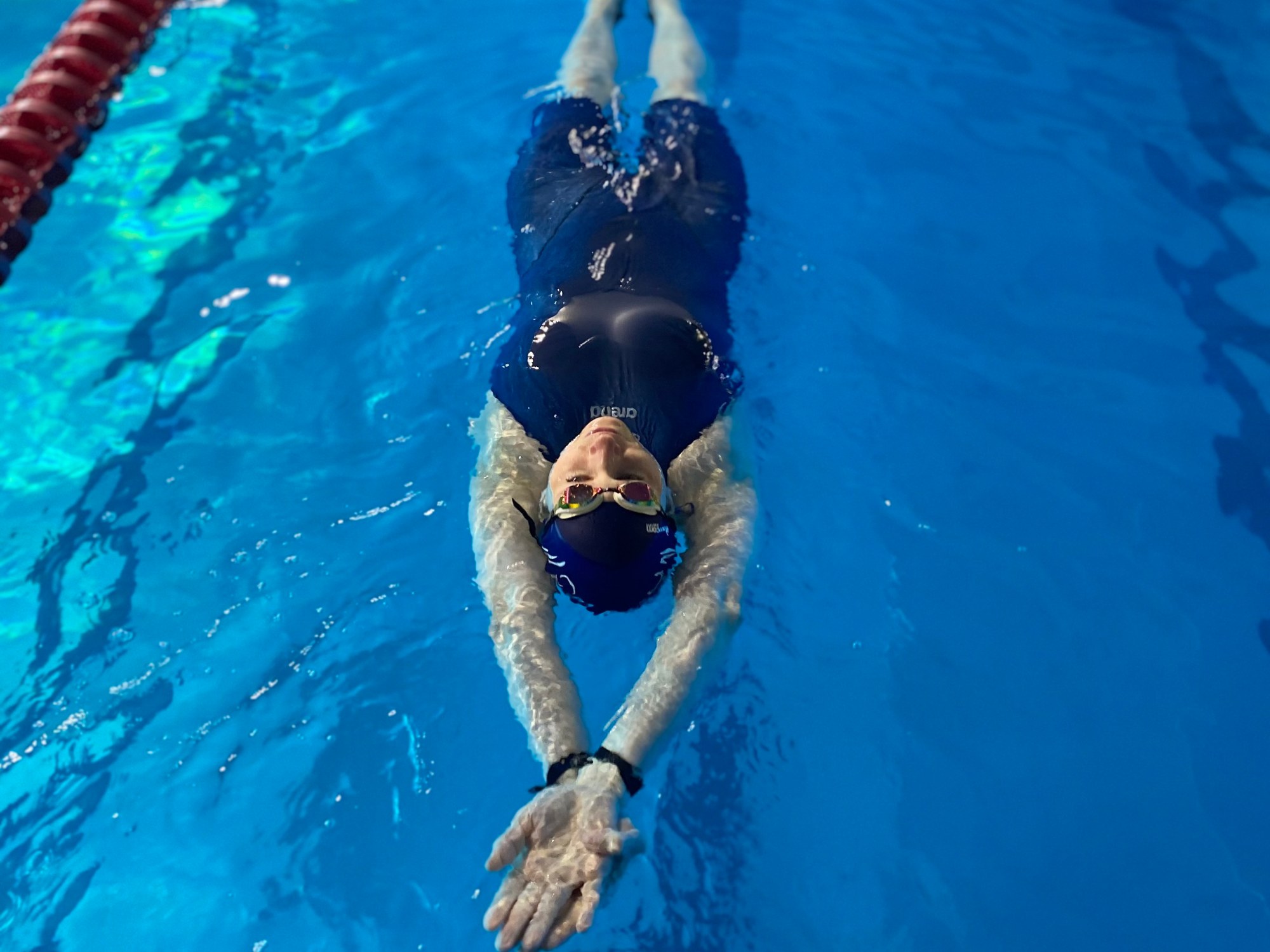
Janina Rossiter, installée en Île-de-France et récemment devenue française, incarne un parcours inspirant entre deux univers : l’apnée et l’art engagé pour l’environnement. Ancienne nageuse de haut niveau, elle trouve dans l’apnée et la nage avec palmes une nouvelle passion qui complète son militantisme artistique pour la protection des océans. À travers ses œuvres visuelles, ses livres pour enfants et ses installations participatives, elle sensibilise à la beauté fragile du monde marin.
Janina Rossiter, Between Two Breaths: Art and Apnea in Service of the Ocean
Janina Rossiter, now based in Île-de-France and recently granted French nationality, is an inspiring figure at the crossroads of two worlds: freediving and environmental art. A former competitive swimmer, she found in freediving and finswimming a new passion that complements her artistic activism for ocean protection. Through visual art, children’s books, and participatory installations, she raises awareness about the fragility and beauty of marine ecosystems.

Entretien avec Janina Rossiter – Interview with Janina Rossiter
Pourquoi fais-tu de l’apnée ? – Why do you freedive?
Je suis nageuse depuis mes 5 ans, la compétition a toujours fait partie de ma vie. L’eau est un univers qui m’a toujours été familier, rassurant. Je m’étais arrêtée un temps pour m’occuper de mes enfants. Et c’est par mon art engagé que je suis revenue à l’eau. J’ai découvert l’apnée grâce à une intervention dans une école, lorsqu’un professeur – devenu ami – m’a parlé d’un apnéiste, Mathieu Maraio. Je ne connaissais pas du tout ce monde, que je continue de découvrir aujourd’hui encore : apnée statique (STA), dynamique avec palmes (DYN), avec monopalme (DYNM), sans palmes (DNF), apnée de vitesse (2×50 m, 8×50 m, 4×50 m…), en profondeur… Il y a tant de disciplines à explorer !
Ce qui m’a attirée au départ, c’est l’apnée de vitesse. J’ai toujours aimé les coulées, les ondulations en natation. Là, je retrouvais mes sensations, avec une contrainte en plus : ne pas respirer. J’ai trouvé ça excitant. Contrairement à beaucoup, ce n’est pas le calme ou la verticalité qui m’ont séduite, mais la glisse et la vitesse. On va plus vite sous l’eau qu’en surface – Michael Phelps l’a prouvé – et c’est grisant !
Mais savoir ce que je voulais ne voulait pas dire que je pouvais le faire tout de suite. Il y a très peu de clubs qui proposent l’apnée de vitesse. En attendant, on m’a conseillé la nage avec palmes (NAP). C’est comme ça que j’ai découvert la NAP, grâce à Guillaume Bourdila.
La NAP et l’apnée font partie de la même fédération en France : la FFESSM. Ce sont des compétitions distinctes, mais complémentaires. Et il y a désormais des épreuves d’apnée dans la NAP, comme le 50 m apnée (1×50). Aux derniers Championnats de France à Limoges, il y avait même une épreuve de 2×50 m. J’espère que ça va continuer à se croiser.
I’ve been a competitive swimmer since I was five. Water has always been a familiar, comforting environment for me. After taking a break to raise my children, I found my way back to the water through my environmental art. I discovered freediving during a school visit, thanks to a teacher—now a friend—who introduced me to freediver Mathieu Maraio. I didn’t know much about freediving at the time, and even today I’m still discovering its many disciplines: static (STA), dynamic with fins (DYN), with monofin (DYNM), without fins (DNF), speed apnea (like 2x50m, 8x50m, 4x50m), and vertical depth diving… The list goes on!
What fascinated me immediately was speed apnea. I’ve always loved underwater glides in swimming, so combining my swimming background with underwater undulation—racing without breathing—felt like an exciting new challenge. While many are drawn to the meditative or depth-focused aspects of freediving, I was hooked by the speed. You actually swim faster underwater than on the surface—Michael Phelps proved that—and that feeling of gliding, of becoming one with the water, was intoxicating.
Knowing what I wanted to do didn’t mean I could do it right away. Speed apnea is a niche discipline. Very few clubs offer it, and it’s difficult to find the right coaching or structure. That’s what led me to finswimming (NAP in France), which I discovered thanks to Guillaume Bourdila while waiting for more opportunities in speed apnea.
Finswimming and freediving both fall under the same federation in France: FFESSM (French Federation of Underwater Sports). While competitions are distinct, it’s possible to practice both. Finswimming now includes some apnea events, such as the 50m apnea (1x50m), and at the last French Championship in Limoges, they even introduced a 2x50m apnea event. I really hope this integration continues, allowing the disciplines to cross over more.
Depuis combien de temps pratiques-tu ? – How long have you been doing this?
Je nage depuis l’enfance, mais j’ai commencé l’apnée vers 40 ans. La NAP est arrivée plus tard, à 43 ans. Je suis un bon exemple : il n’y a pas d’âge pour découvrir de nouvelles passions ou repousser ses limites !
Je vis en France depuis presque 15 ans. Et pour moi, l’apnée fait partie de cette culture française que j’ai adoptée. C’est un sport plus développé ici qu’ailleurs. Je suis d’origine allemande, et depuis mars 2025 je suis aussi française. C’est un vrai plaisir et une fierté d’avoir cette double culture, et de la vivre à travers l’eau.
I started swimming competitively at age five. I discovered freediving much later, at 40, and started finswimming at 43. It just shows—there’s no age limit to discovering new passions and pushing your limits!
I’ve lived in France for nearly 15 years now, and over time, I’ve come to embrace French culture more deeply. For me, freediving is part of that—it’s a sport deeply rooted in France, more than in many other countries. I’m originally from Germany, and I’m proud to say I officially became a French citizen in March 2025. Being French gives me a strong sense of belonging, and I’m grateful to embrace this culture through freediving.
Quel conseil donnerais-tu à une jeune femme qui commence ? – What advice would you give to a young woman starting freediving?
Comme dans tout, il faut chercher ce qui nous plaît, et suivre cette joie. L’apnée est un sport très riche : statique, dynamique, profondeur, vitesse… Il y a de tout ! C’est à chacune de trouver ce qui la fait vibrer.
J’ai commencé la NAP en septembre 2024 grâce à Guillaume et à Mathieu qui m’y ont encouragée. Moi, je voulais faire de l’apnée de vitesse, mais aucun club près de chez moi ne la proposait. On m’a dit que la NAP pouvait être une bonne préparation. Et je suis tombée amoureuse de cette discipline !
L’an dernier, j’étais un peu perdue dans mon club d’apnée. J’étais la seule avec une monopalme, je n’avais pas vraiment de conseils. Ce sont des gens rencontrés sur Instagram qui m’ont beaucoup aidée. Regarder les championnats de France en direct sur la chaîne de la FFESSM aussi. J’ai appris quel matériel utiliser, quelle palme, quelle combinaison… juste en observant. Et toi, Karine, tu es venue l’an dernier dans notre club pour nous enseigner l’ondulation. Ça m’a aidée à comprendre le geste, le matériel… Mais savoir courir ne veut pas dire qu’on peut faire un marathon tout de suite. L’apnée de vitesse, c’est trois ou quatre entraînements par semaine. Il faut s’engager.
As with anything in life, find what excites you and go for it. Freediving is a multifaceted sport—static, dynamic, depth, speed—there’s so much to explore. The key is to discover what you love about it, because joy is what drives progress.
I only started finswimming in September 2024, encouraged by Guillaume Bourdila and my friend Mathieu Maraio. My heart was set on speed apnea, but no nearby clubs offered it. I was advised to start with finswimming as a stepping stone—and thank you, Guillaume, because I absolutely fell in love with it! Now I’m curious to see where this journey will lead.
Last year, I felt a bit lost in my apnea club—alone with my monofin and no real guidance. That’s when I connected with a few people on Instagram who really helped me improve. Watching the French Championships live on the FFESSM channel also taught me a lot—about gear choices like monofins, suits, and materials like carbon. Just observing helped me grow.
And Karine—last year, you kindly came to our club to teach us about undulation. That helped me understand both the movement and the gear better. But, like anything, knowing how to run doesn’t mean you can do a marathon right away. Speed apnea requires dedication—three to four sessions a week.
Tu fais de la compétition ? Depuis quand ? Quelle est ta discipline préférée ? – Do you compete? If so, since when, and what’s your favorite discipline?
Oui, j’ai commencé les compétitions de NAP en septembre 2024.
Puis en mars 2025, j’ai fait ma première compétition d’apnée, en 2×50 m. Mon objectif était de faire 100m avec une respiration courte au milieu. Je l’avais fait à l’entraînement, mais pas ce jour-là. J’ai fait un 50 m en 28 secondes, je suis repartie, j’étais bien… mais à 75 m, mon corps a dit stop. Je suis sortie, j’ai eu un carton rouge. Disqualifiée. Mais je le fais pour moi, pour le plaisir. Il n’y a pas de danger. Parfois, le stress prend le dessus, on oublie de s’amuser. Pourtant, c’est ça qui me motive : le bonheur de bouger dans l’eau, de ressentir l’élément. J’ai voulu partager ce moment parce que souvent, on montre uniquement ce qui réussit. Mais c’est bien aussi de dire quand ça ne marche pas. On apprend tous ensemble. Je savais pourquoi ça n’avait pas marché : c’était ma première compétition. Et dans cette discipline, il faut annoncer un temps – sinon tu es pénalisée. C’est très différent de la NAP, où tu n’annonces rien. À la fin de mon premier 50 m, les juges ont crié « Vas-y, vas-y ! », alors j’ai replongé, sans me reposer. Mais j’étais fatiguée. Ce n’était pas le bon moment. Et puis, j’étais malade la veille. J’ai senti que mon corps n’était pas au top. Heureusement, j’étais bien entourée : mon club CNHC – Club Nautique de Houilles Carrières, mon coach, même le président de la FFESSM NAP était là. Ils m’ont soutenue malgré mon échec. Ça m’a fait du bien. J’avais aussi un problème de monopalme : elle n’était pas adaptée. Il faut une bonne lame, pour ne pas se fatiguer. Le bon matériel aide à économiser l’oxygène.
Mais il y a aussi de très bonnes nouvelles : j’ai terminé ma première saison complète de NAP en bassin aux Championnats de France ! C’était fou : deux jours intenses, du stress, des surprises, de la fierté :
- 🥇 1ère place en relais – médaille d’or et record de France (MPF)
- 🥈 2ème place – vice-championne de France (individuel)
- 🥉 deux fois 3ème
- 4ème place sur une autre course
J’ai nagé plus vite sur toutes les distances, sauf la dernière – j’étais épuisée. Mes épreuves : 100BI, 50BI, 100SF, 400BI, 100BI et 200BI (BI = bi-palmes, SF = souvent monopalme avec tuba).
J’ai aussi fait plusieurs 50m en apnée lors de compétitions NAP. J’ai réussi à me hisser dans le classement régional Île-de-France.
La NAP, n’est pas de l’apnée au sens strict, mais elle inclut cette discipline dans les compétitions. Les deux se complètent très bien. Cela m’a permis de progresser. En apnée, les clubs ne s’entraînent pas aussi souvent. Mais pour faire de la vitesse, il faut du cardio. Aujourd’hui, je suis fière d’être championne de France par équipe et vice-championne en individuel. C’est une belle étape pour moi !
Yes, I started competing in September 2024 with finswimming.
I entered my first freediving competition in March 2025, attempting the 2x50m apnea. My goal was to swim the full 100 meters with a short breathing at midpoint—something I could do in training. But I didn’t succeed on competition day. I reached the first 50 meters in 28 seconds and felt fine, but at 75 meters, my body said stop. I surfaced and got a red card—disqualified. Still, I do this for fun and without risk. Sometimes stress gets the better of you and you forget to enjoy the moment—the joy of moving in water, this element that motivates me every day. I wanted to share that moment because success isn’t the full story. Social media often shows the wins, but there’s value in showing when things don’t go as planned. We can learn from each other’s journeys. I knew what had gone wrong that day. It was my first apnea competition. The format was unfamiliar. Unlike in finswimming, in apnea you have to announce your target time or get penalized. During my turn, the judges shouted “Go, go, go!”—so I didn’t rest and immediately dived again. But I was already too tired. They meant to encourage me, but it only added pressure. If I’d had more confidence, I might’ve handled it better. Also, the day before the competition I felt unwell—maybe stress, maybe a virus. I knew I might not be at my best. On the bright side, my new team CNHC – Club Nautique de Houilles Carrières, my coach, and the FFESSM NAP president were all there to cheer me on. That meant a lot—especially after failing. Their support really lifted me. Another issue was my monofin—it wasn’t the right one. The right blade reduces fatigue because the return movement is automatic, which saves oxygen. But on an even more positive note—I just completed my first full NAP pool season at the French Championships!
It was an incredible experience: two adrenaline-filled days, full of surprises, exhaustion, and pride:
- 🥇 1st place – Gold medal and new French record (MPF) in team relay
- 🥈 2nd place – Vice-Champion of France (individual)
- 🥉 Two 3rd places
- 4th place in another event
I swam faster in every race except the last one—after five races, I was wiped out! My events included: 100BI, 50BI, 100SF, 400BI, 100BI, and 200BI (BI = bi-fins, SF = usually monofin with snorkel). I also competed in several 50m apnea races during NAP events and placed 2nd overall in the Île-de-France regional rankings. Even though finswimming isn’t technically apnea, the disciplines are very close, and it’s helped me improve tremendously. Most apnea clubs don’t train multiple times a week—but for speed apnea, you need strong cardio. I’m proud to say I’m now French champion with my team, and vice-champion individually—a big milestone in my sporting journey!
En dehors de la piscine, tu es aussi une artiste engagée. Peux-tu nous en dire plus ? – Outside the pool, you’re a committed artist. Can you tell us more about your work?
Je suis artiste, illustratrice et autrice jeunesse engagée pour la protection des océans. Je travaille à la croisée de l’art visuel et de l’écologie, à travers des livres, des fresques, des expositions. Je fais de l’art minimaliste autour de la biodiversité marine, de la pollution plastique, du changement climatique…
L’art est un langage universel. On peut toucher les enfants comme les adultes. C’est un chemin difficile parfois, mais je suis venue à l’art par amour de l’océan, et je continue par engagement. La mer est mon refuge, mon ancrage. Elle m’aide à revenir à l’instant présent.
Je fais de l’artivisme – l’art comme moyen d’action – souvent en collaboration avec des enfants, dans les écoles ou lors d’installations participatives. Mon but est de créer de l’émotion, du lien, et de montrer que la beauté du monde est aussi sa fragilité.
Mon illustration Mangrove a été exposée à la COP26 dans la zone officielle des Nations Unies. Cela m’a apporté une grande visibilité. L’œuvre a reçu un prix, ce qui m’a beaucoup encouragé à continuer.
I’m an artist, illustrator, and children’s author committed to ocean protection. My work combines visual art with environmental awareness through books, illustrations, and exhibitions. I use minimalist marine art to address topics like plastic pollution, biodiversity, and climate change.
Art is a universal language that can reach children and adults alike. It’s not always easy or predictable, but my love of the ocean brought me here—and keeps me going. The sea is my anchor, my refuge, where I reconnect with the present.
I focus on artivism—using art for activism—often through participatory projects with children, collaborative murals, or immersive installations. My goal is to create emotional connection and inspire change by showing both the beauty and the fragility of our oceans.
My illustration Mangrove was exhibited in the Blue Zone at COP26, which gave my work great visibility. It later won an award—a deeply motivating moment that encouraged me to keep creating and advocating.
Tu participes à des événements internationaux ? – You participate in many international events, can you tell us more?
Oui, j’ai eu la chance de présenter mes projets dans plusieurs grands événements :
- La COP26 à Glasgow
- Le congrès mondial IMPAC5 à Vancouver
- La Conférence des Nations Unies sur l’Océan 2025 à Nice, avec l’exposition Tidal Shifts et un atelier UNESCO
- La World Ocean Week 2022 à New York avec The Explorers Club
- ChangeNOW au Grand Palais
- La POLITICO Sustainable Future Week à Bruxelles
Mais j’interviens aussi dans des galeries, des écoles, ou des festivals locaux. Je fais de la sensibilisation avec mes livres et mes dessins.
Site internet : https://janinarossiter.com
Instagram : @janinarossiter
Yes! I’ve had the opportunity to share my work at global environmental events like:
- COP26 in Glasgow
- IMPAC5, the World Congress on Marine Protected Areas in Vancouver
- UN Ocean Conference 2025 in Nice, with the exhibition Tidal Shifts and an official UNESCO WOW25 workshop
- World Ocean Week 2022 in New York with The Explorers Club, where I led their Drawing Challenge
- ChangeNOW at the Grand Palais
- POLITICO Sustainable Future Week in Brussels
I also exhibit in smaller, independent galleries and regularly host ocean education workshops in schools, using my books and illustrations as educational tools.
Website: https://janinarossiter.com
Instagram: @janinarossiter
Janina Rossiter incarne la puissance d’un engagement double : sportif et artistique. Son parcours prouve qu’il n’y a pas d’âge pour renouer avec sa passion, explorer de nouveaux horizons et contribuer à un monde meilleur – que ce soit en repoussant ses limites dans l’eau ou en mobilisant l’art pour éveiller les consciences. Son message est clair : suivez ce qui vous fait vibrer, et l’eau, la vitesse, l’océan – ou l’art – vous le rendra.
Janina Rossiter embodies the power of dual commitment – sport and activism. Her story proves that it’s never too late to rediscover your passion, embrace new challenges, and contribute meaningfully to the world – whether by pushing limits in the water or creating art that inspires change. Her message is clear: follow what makes you come alive. The water – and the world – will thank you for it.
 Apnoïa, l'apnée au féminin