
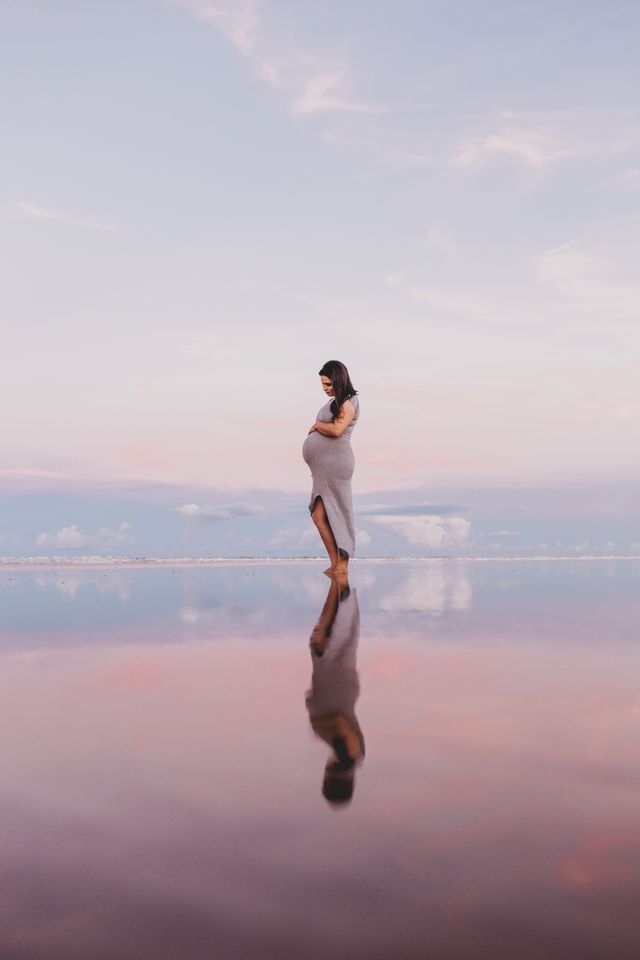
Devenir mère quand on est apnéiste, c’est traverser une période où le corps ne nous appartient plus tout à fait de la même façon. Le rapport au souffle, à l’effort, à la profondeur, tout se réorganise autour d’une seule priorité : protéger la vie qui grandit, puis celle qui vient de naître. Il n’existe pas de chemin unique. Chaque grossesse, chaque post-partum, chaque corps dessine sa propre trajectoire dans l’eau.
Trois apnéistes, trois grossesses, trois chemins
Ce que montrent les témoignages d’apnéistes de haut niveau qui partagent leur parcours ces derniers mois, c’est qu’il n’existe pas une seule bonne façon de vivre sa grossesse en tant qu’apnéiste.
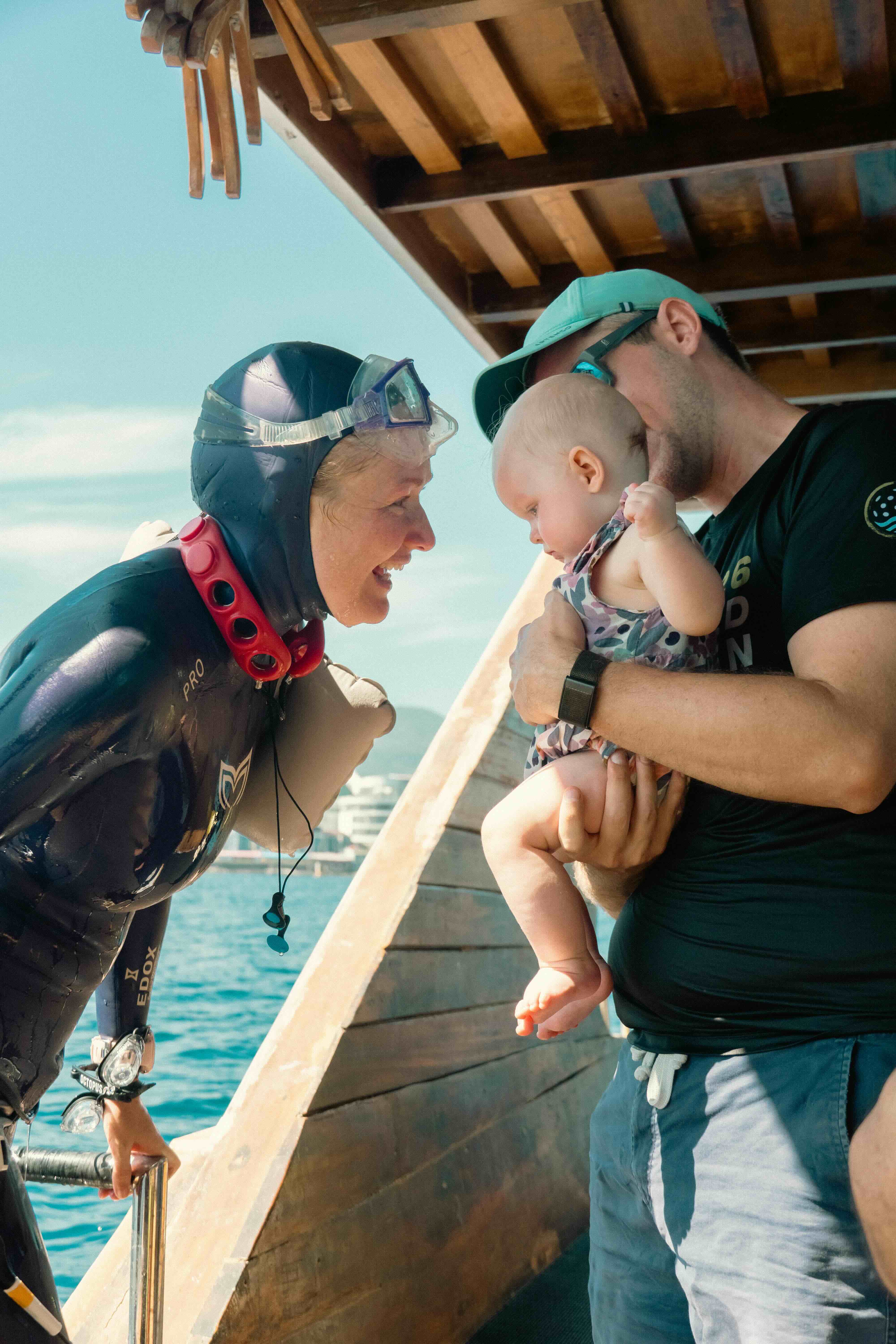
Marianna Hames, plusieurs fois championne du monde française, a découvert sa grossesse quelques jours avant les Championnats du monde en piscine 2025, pour lesquels elle s’était préparée avec des distances de plus de 200 mètres en apnée. Elle raconte, dans un témoignage publié début 2026 par Fourth Element, avoir choisi de se retirer de la compétition non par renoncement mais par un acte de responsabilité envers son corps et l’enfant à venir. Elle a ensuite continué à s’entraîner de façon adaptée tout au long de sa grossesse, en insistant sur le fait que le plus difficile n’a pas été physique mais mental : accepter que son corps change, sans se sentir obligée de le cacher ou de faire comme si de rien n’était. Six mois après son accouchement, elle a disputé sa première compétition de profondeur et l’a remportée. Une photo touchante capture sa famille réunie autour de ce beau retour à la compétition.
Lily Crespy, instructrice-formatrice française installée à Nice, a partagé un témoignage sur sa propre grossesse dans un article publié mi-avril 2026 par Alchemy. C’est sa première grossesse, à 44 ans, après un long parcours de PMA. Sa décision a été radicale et très personnelle : zéro apnée pendant toute la grossesse. Elle a néanmoins continué à coacher à distance, remarquant au passage que son envie de respirer survenait bien plus vite qu’avant, même sur de très courtes apnées d’équilibrage. Un choix assumé, sans regret, en attendant de replonger « en maman apnéiste », comme elle le formule elle-même.
Iru Balic, apnéiste vénézuélienne, décrit une expérience presque opposée entre ses deux grossesses, dans ce même article d’Alchemy. Pour la première, l’instinct l’a menée seule vers l’océan, simplement pour flotter et respirer dans son tuba, sans même savoir encore qu’elle était enceinte. Après la naissance de sa fille, elle a choisi de reprendre la compétition rapidement, allaitant juste avant de plonger. Elle décrit cette expérience comme la révélation de ce dont son corps était capable, mais aussi comme le moment où elle s’est sentie la plus vulnérable dans l’eau. Pour sa deuxième grossesse, tout a été différent : plus d’énergie, plus d’envie de rester active, d’enseigner, de nager jusqu’au bout.
Mon expérience : continuer, s’arrêter, revenir
J’ai débuté l’apnée avant la naissance de ma première fille. Pendant la grossesse, j’ai arrêté les entraînements d’apnée pure, mais j’ai continué à nager jusqu’à l’accouchement. La reprise s’est faite dès que j’ai reçu le feu vert de mon gynécologue, soit quelques mois après la naissance. Et oui, c’est possible même lorsque l’on allaite : il suffit d’écouter son corps et de lui laisser le temps dont il a besoin, sans forcer le calendrier.
Pour ma deuxième fille, l’expérience a été plus simple encore. Plus aucune appréhension cette fois, une confiance déjà acquise qui m’a permis de profiter pleinement de la grossesse et de la pratique, sans crainte. Ce que la première grossesse m’avait appris en vigilance, la seconde me l’a rendu en sérénité.
Ce que ces histoires ont en commun
Aucune de ces trajectoires ne ressemble à une autre, et c’est précisément ce qu’elles nous enseignent. La grossesse modifie profondément la mécanique respiratoire : le diaphragme se déplace, le volume sanguin augmente, la sensibilité au CO2 s’accroît. Cela explique cette envie de respirer plus précoce que décrivent de nombreuses apnéistes enceintes. La plupart des professionnels de santé recommandent d’ailleurs de suspendre l’apnée pure pendant la grossesse, même si la recherche médicale sur le sujet reste encore limitée.
Le retour post-partum, lui, n’est jamais linéaire. Le plancher pelvien et la sangle abdominale ont besoin de temps pour se reconstruire, les hormones mettent plusieurs mois à se stabiliser, la fatigue du quotidien avec un nouveau-né influence directement la récupération. Ce qui revient dans tous les témoignages, c’est l’importance d’une progression douce, sans comparaison avec le niveau d’avant, et d’un suivi médical qui accompagne plutôt qu’il n’impose.
Être mère et être apnéiste ne sont pas deux identités qui s’opposent. Elles se réorganisent, se répondent, et finissent souvent par se nourrir l’une l’autre : une présence plus grande à soi dans l’eau, une patience apprise ailleurs et retrouvée sous la surface.
Et vous, comment avez-vous vécu (ou envisagez-vous) l’apnée pendant votre maternité ?
N’hésitez pas à partager votre propre expérience en commentaire.
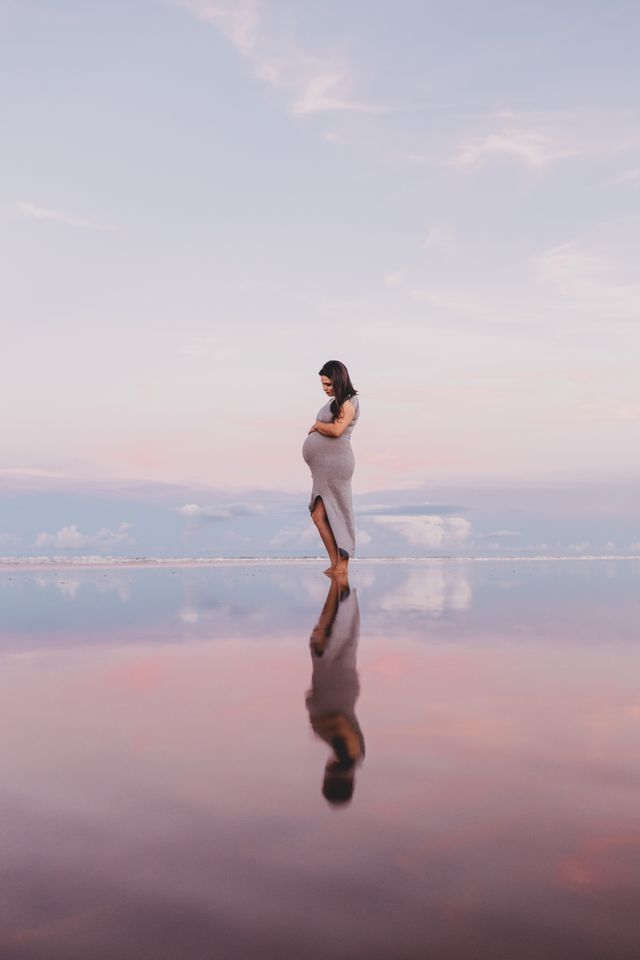
Crédit Photo : Jonathan Borba
For English readers,
Freediving and motherhood: diving before, during, and after
Becoming a mother as a freediver means going through a period where the body no longer fully belongs to you in the same way. The relationship to breath, effort, and depth reorganises itself around a single priority: protecting the growing life, then the one that has just been born. There is no single path. Each pregnancy, each postpartum period, each body draws its own trajectory in the water.
Three freedivers, three pregnancies, three paths
What recent testimonies from elite freedivers show is that there is no single right way to experience pregnancy as a freediver.
Marianna Hames, a multi-time French world champion, discovered she was pregnant just days before the 2025 World Freediving Championships in the pool, for which she had trained with distances exceeding 200 meters in apnea. In a testimony published in early 2026 by Fourth Element, she describes her choice to withdraw from the competition not as a surrender but as an act of responsibility toward her body and her unborn child. She continued to train in an adapted way throughout her pregnancy, emphasizing that the most difficult aspect was not physical but mental: accepting that her body was changing without feeling obligated to hide it or pretend nothing was happening. Six months after giving birth, she competed in her first depth competition and won it. A touching photograph captures her family gathered around this beautiful return to competition.
Lily Crespy, a French freediving instructor trainer based in Nice, shared her own pregnancy story in an article published in mid-April 2026 by Alchemy. It is her first pregnancy, at 44, after a long fertility treatment journey. Her decision was clear and deeply personal: zero freediving throughout the pregnancy. She kept coaching remotely, however, and noticed how much faster the urge to breathe came, even during very short equalisation holds. A choice she stands by fully, with no regrets, while she waits to dive again as a « freediving mama, » in her own words.
Iru Balic, a Venezuelan freediver, describes an almost opposite experience between her two pregnancies, in the same Alchemy piece. During the first, instinct drew her alone to the ocean, simply to float and breathe through her snorkel, before she even knew she was pregnant. After her daughter was born, she chose to return to competition quickly, breastfeeding right before diving, an experience she describes as both a revelation of what her body was capable of and the moment she felt most vulnerable in the water. Her second pregnancy felt completely different: more energy, a stronger drive to stay active, to teach, to keep swimming until the very end.
My own experience: continuing, pausing, returning
I started freediving before the birth of my first daughter. During the pregnancy, I stopped pure freediving training but kept swimming right up until delivery. I resumed as soon as I got the green light from my gynaecologist, a few months after birth. And yes, it is possible even while breastfeeding: you simply need to listen to your body and give it the time it needs, without forcing the timeline.
With my second daughter, it was even simpler. No apprehension this time, just a confidence I had already built, which let me fully enjoy both the pregnancy and the practice, without fear. What the first pregnancy taught me in vigilance, the second gave back to me in serenity.
What these stories have in common
None of these paths look alike, and that is precisely the lesson. Pregnancy deeply reshapes breathing mechanics: the diaphragm shifts, blood volume increases, sensitivity to CO2 rises. This explains the earlier urge to breathe that many pregnant freedivers describe. Most health professionals recommend pausing pure freediving during pregnancy, even though medical research on the topic remains limited.
Postpartum recovery, meanwhile, is never linear. The pelvic floor and core need time to rebuild, hormones take several months to stabilise, and the daily fatigue of caring for a newborn directly affects recovery. What comes up in every account is the importance of a gentle progression, without comparison to a previous level, guided rather than dictated by medical follow-up.
Being a mother and being a freediver are not opposing identities. They reorganise around each other, respond to each other, and often end up nourishing one another: a deeper presence with oneself in the water, a patience learned elsewhere and rediscovered beneath the surface.
And how have you experienced (or how do you picture) freediving through motherhood?
Feel free to share your own experience in the comments.
 Apnoïa, l'apnée au féminin